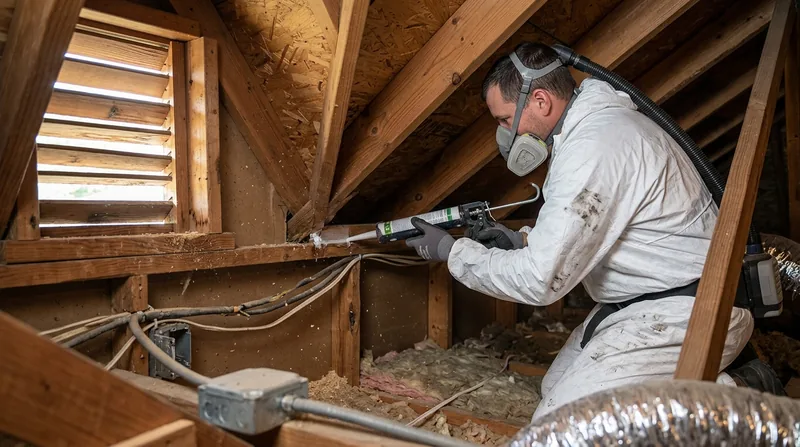




Leaky top plates, wiring penetrations, and gaps around ductwork are the invisible drains in Columbia homes, letting conditioned air escape year-round and letting humidity creep inward through walls during hot summers and back out during winter cold snaps. Air sealing in Columbia closes these gaps with spray foam or sealant, cutting drafts and stabilizing interior humidity before it damages framing and drives up heating and cooling costs. In a mixed-humid climate like Boone County, where vented attics bake through Missouri summers and lose heat fast in January freezes, sealing the top plate and wall penetrations is often the difference between a home that breathes right and one that fights moisture and temperature swings every season. Older homes near downtown Columbia and the University of Missouri campus, many with shallow attic insulation and balloon framing, are particularly vulnerable to these leaks. We help homeowners and builders in Columbia, Ashland, Hallsville, Centralia, and throughout the region identify where air is escaping and seal it with precision. Air sealing is often paired with attic spray foam insulation for maximum efficiency, but it also stands alone as a high-ROI retrofit.
Why Air Sealing Matters in Columbia's Mixed-Humid Climate
Columbia sits in IECC climate zone 4A, where hot humid summers push moisture inward through walls and attics, and cold winters reverse the drive and push moisture back out. Uncontrolled air leakage amplifies both problems. In summer, humid outside air infiltrates through cracks at the top plate and around penetrations, cooling equipment runs longer to dehumidify, and moisture accumulates in rim joists and band joists where it feeds wood rot and mold. In winter, conditioned indoor air escapes through the same gaps, heating costs spike, and the pressure difference can pull cold air and moisture into wall cavities where it condenses on framing. Top plates in homes built before 1980 are rarely caulked or sealed, and newer construction often misses penetrations entirely during framing. Rooms over garages, older basements with leaky rim joists, and attics with unsealed ductwork are the worst offenders across the region.
- Seal gaps at the top plate where walls meet the attic or roof deck to stop warm air rising in winter and humid air infiltrating in summer.
- Close holes and gaps around electrical wiring, plumbing vents, and ductwork that penetrate the thermal boundary.
- Reduce the load on heating and cooling equipment by stopping uncontrolled air exchange.
- Lower humidity swings that cause wood framing to expand and contract, cracking drywall and stressing fasteners.
- Extend the life of insulation and building materials by keeping moisture out of the envelope.
Air sealing is the single most cost-effective way to improve comfort and durability in homes across Columbia and Boone County.
Key info: A typical Columbia home loses 20 to 30 percent of its conditioned air through top plate leaks and penetrations. Sealing these gaps alone can cut heating and cooling demand by 10 to 15 percent, depending on how severe the leakage is. In a home with $150 per month in heating and cooling costs, that translates to real money saved every month.
For details on regulations governing air sealing and thermal barriers in Columbia, consult the City of Columbia Building and Development Services office to confirm what code applies at your address.
How We Seal Air Leaks in Columbia Homes and Buildings
Air sealing starts with a careful walk-through to identify where air is escaping. We look for gaps at the top plate, unsealed ductwork, wiring penetrations, and rim joists where the band joist meets the rim band. In attics with vented soffits and gable vents, we seal the top plate and wall penetrations while preserving attic ventilation or converting to a sealed roof deck with spray foam. In crawl spaces and basements, we seal rim joists and band joists to stop air movement through the rim band and into the wall cavities above. In garages and metal buildings, we seal walls and roof penetrations to control condensation and stop humid air from entering the building envelope. Once we identify the leaks, we use spray foam or caulk to seal them, depending on gap size and accessibility.
- Walk through the home or building to locate top plate gaps, ductwork penetrations, wiring holes, and rim joist leaks.
- Mark and measure gaps to determine whether spray foam or sealant is the right tool.
- Seal top plates and wall penetrations with spray foam to stop air movement and improve R-value.
- Seal rim joists and band joists with closed-cell spray foam to control moisture and air infiltration from the crawl space.
- Test and document the work to confirm the leaks are closed.
The result is a tighter envelope that holds conditioned air where it belongs and keeps moisture-laden outside air from infiltrating the walls and attic.
Example: A mid-century ranch in Columbia with a vented attic and shallow fiberglass insulation typically has 15 to 20 penetrations at the top plate where ductwork, wiring, and plumbing run through. Sealing those gaps with spray foam takes 4 to 6 hours and costs between $800 and $1,200. A rim joist retrofit in an older basement in Ashland, where moisture is pushing up through the rim band into the walls above, takes 6 to 8 hours and runs $1,200 to $1,800 depending on how many linear feet need sealing.
For more information on how spray foam works in attics, see our page on attic spray foam insulation in Columbia.
| Sealing Method | Description | Best For |
|---|---|---|
| Closed-cell spray foam | High-density foam that seals and insulates, R-value 6 per inch, vapor-impermeable once cured. | Rim joists, band joists, crawl spaces, and any gap where moisture control is critical. |
| Open-cell spray foam | Lower-density foam that seals and insulates, R-value 3.5 per inch, vapor-permeable when cured. | Top plates and wall penetrations in vented attics where breathability is acceptable. |
| Polyurethane caulk | Flexible sealant that adheres to wood, metal, and concrete, rated for temperature swings. | Small gaps around wiring, plumbing, and ductwork where spray foam is overkill. |
| Combination approach | Spray foam for large gaps and critical zones, caulk for smaller penetrations and detail work. | Complete air sealing jobs where efficiency and cost control both matter. |
Air Sealing Cost in Columbia: What to Expect
Air sealing in Columbia typically runs from $650 to $2,500 depending on the scope and accessibility of the leaks. A small retrofit sealing top plate gaps and a handful of penetrations in a single-story home costs around $800 to $1,200. A full rim joist and band joist sealing in a basement or crawl space, where linear footage is high and access is tight, runs $1,500 to $2,500. Accessibility matters: attics with full headroom and a safe walkway are cheaper to seal than cramped, low-clearance spaces where crews must work in tight quarters. The number and size of penetrations also drives cost. A home with a complex HVAC system, multiple plumbing vents, and electrical runs scattered across the top plate takes longer to seal than a simpler layout.
Getting two or three written estimates before booking is always smart. Each estimate should specify the square footage or linear footage being sealed, the type of foam or sealant being used, and the R-value and thickness of any spray foam applied. Avoid estimates with no detail on what is being sealed or how. A reputable contractor will also note any obstacles, such as asbestos-containing materials that require special handling or moisture that needs addressing before sealing begins.
For a full pricing breakdown and examples of typical jobs, see our air sealing pricing page.
What to Look for When Hiring an Air Sealing Contractor Near Columbia
Hiring the right contractor for air sealing is about verifying their insurance, understanding their process, and checking references from recent jobs in your area. Start by asking for proof of insurance and confirming that they are fully insured for spray foam work. Call two or three references from homes or buildings in Columbia, Ashland, or Hallsville to ask how the work held up and whether the contractor was responsive after the job. Ask each contractor for a written estimate that breaks down what is being sealed, the materials being used, and the cost. Avoid contractors who promise immediate re-entry or who spray foam over wet or contaminated surfaces. A contractor who says no to a job because moisture or mold is present is a contractor who knows the trade.
Permitting for air sealing is rarely required in Columbia, but always confirm with the building department at your address before work begins. Some older homes have asbestos-containing insulation or sealant, and that material must be left alone and flagged for a licensed professional. If your home is in an HOA or historic district, check whether architectural approval is needed for any visible exterior work, though air sealing is typically interior only.
Ready to get started? Contact Columbia Spray Foam Insulation for a free, no-obligation estimate. Call (573) 685-4104 or fill out the form on our contact page, and we will respond within 24 hours with a time to walk through your home and provide a written estimate with all the details.
Air Sealing in Columbia: Pricing Guide
| Service | Price | Details |
|---|---|---|
| Top plate and penetration sealing | Starting at $650 | Small gaps and single-story attic work, includes foam and basic caulk for wiring and ductwork penetrations |
| Rim joist and band joist sealing | Starting at $1,200 | Basement or crawl space retrofit, cost scales with linear footage and access difficulty in tight spaces |
| Full-home air sealing retrofit | Starting at $1,500 | Top plate, rim joists, wall penetrations, and ductwork, typical mid-size Columbia home with moderate complexity |
| Complex or large-scale job | On estimate | Multi-story homes, extensive rim joist work, or moisture remediation required before sealing can proceed |
| Travel | Included | No separate mileage or travel fee within Columbia and surrounding service areas |
| Estimate | Free | Written estimate with materials and labor detail provided within 24 hours, no obligation to book |
Indicative pricing, the exact cost depends on square footage, finish, and site access. Free personalized estimate within 24h at (573) 685-4104.


