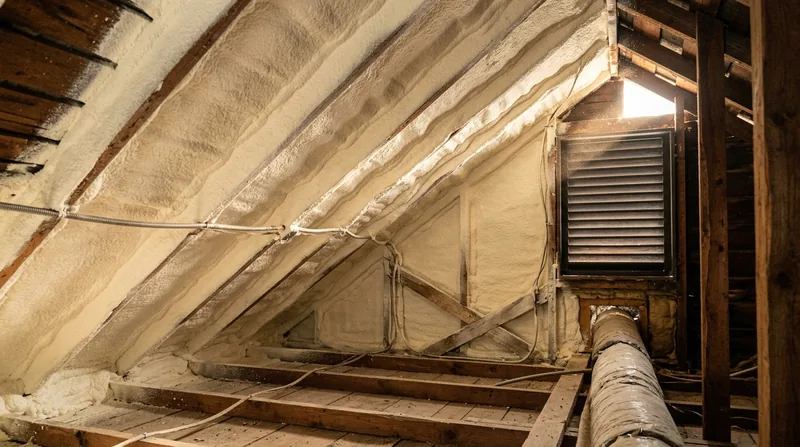




Attic spray foam insulation in Columbia cuts cooling bills in summer heat and heating bills during winter cold snaps by sealing the attic floor or roof deck against air leakage. Columbia's older homes near downtown and the University of Missouri campus, along with mid-century ranches across established neighborhoods and newer subdivisions spreading toward Ashland, all sit in IECC climate zone 4A mixed-humid. That means hot, humid summers that push moisture inward through walls and attics, and cold winters with hard freezes and ice storms that reverse the drive. Vented attics bake all summer and lose heat fast in January, so both cooling and heating bills swing hard. We seal the attic with spray foam sized for this climate, cutting energy costs and stopping the air leakage that makes rooms over garages and spaces above rim joists stay too hot or too cold. Call us at (573) 685-4104 for a free, no-obligation estimate.
Why Attic Spray Foam Insulation Matters in Columbia's Hot, Humid Climate
Columbia summers push temperatures into the low 90s with high humidity, and that moisture-laden air works against fiberglass and cellulose insulation. A vented attic does not stop air leakage from the conditioned space below, so cool air escapes past the insulation and into the hot attic, making the AC work harder. In winter, warm air from heated spaces rises into a vented attic, hits the cold roof deck, and condenses into water vapor that soaks into framing and ductwork. Spray foam seals both the air barrier and the thermal barrier in one pass, stopping the cycle entirely. That sealed envelope cuts both cooling and heating bills, and it stops the moisture damage that rots rim joists and makes crawl spaces stay damp all year.
- Sealed attics stop air leakage and moisture infiltration that vented attics cannot control.
- Spray foam holds its R-value year-round, unlike fiberglass that settles and loses performance over time.
- A sealed roof deck eliminates the hot attic that drives summer cooling costs up 20 to 30 percent.
- Condensation on ductwork and framing in winter is eliminated when the attic temperature stays close to indoor conditions.
These are the failure modes that dominate attic insulation in Boone County and surrounding areas, and spray foam fixes all of them in one job.
Key info: Columbia's building code requires a thermal barrier between spray foam and living spaces, and an ignition barrier on foam exposed in attics. The fifteen-minute thermal barrier distinction is the technical rule most generalists get wrong. Your local building department in Columbia (or Ashland, Hallsville, or Centralia if you are outside city limits) governs what applies at your address. We help you navigate those requirements and submit for permits where they apply.
For more on how spray foam handles moisture in crawl spaces and basements, see our crawl space spray foam insulation page.
How We Seal Your Attic: Step-by-Step Spray Foam Installation in Columbia
We start with a site visit to measure the attic space, check for moisture, damaged framing, or existing insulation that needs removal, and confirm that the substrate is clean and dry. We specify the foam type (closed cell or open cell), thickness, and R-value in writing before we begin, so you know exactly what you are paying for. During the spray, we control the application rate, maintain proper drum temperature, and run mechanical ventilation to manage cure odors. We do not re-enter the space or turn on HVAC until twenty-four to forty-eight hours have passed, giving the foam time to fully cure and off-gas. Once cured, the foam is inert and safe, and we walk through the finished attic with you to confirm coverage and answer any questions.
- We inspect the attic for moisture, mold, or structural damage and address wet substrates before any foam is sprayed.
- We provide a written estimate specifying R-value, foam type, and thickness in board feet so you know the scope before work starts.
- We seal all penetrations, rim joists, and band joists while we are in the attic, stopping air leakage at the source.
- We maintain mechanical ventilation during cure and enforce a re-entry window of twenty-four to forty-eight hours before the space is occupied or HVAC is turned on.
- We inspect the finished job with you and provide documentation of the work completed.
This process ensures the foam cures properly, odors dissipate safely, and your attic stays sealed and conditioned for years to come.
Local example: A 1960s ranch in Columbia with a vented attic and R-19 fiberglass had an AC bill of $240 a month in July. The attic temperature hit 145 degrees F, and the rim joists showed signs of moisture damage. We sealed the roof deck with 5.5 inches of closed cell foam (R-33), sealed the rim joists, and removed the old fiberglass. By the following summer, the AC bill dropped to $160 a month, and the attic temperature stayed below 95 degrees F.
For details on how we handle air sealing around the attic perimeter, see our air sealing page.
Attic Spray Foam Insulation Methods: Closed Cell vs. Open Cell
| Approach | Description | Best for |
|---|---|---|
| Closed Cell Spray Foam | Dense, rigid foam with an R-value of 6 to 7 per inch. Stops air and vapor. Cures in minutes. | Sealed roof decks in zone 4A mixed-humid climate. Attics with moisture risk. Rim joists and band joists. |
| Open Cell Spray Foam | Soft, flexible foam with an R-value of 3.5 to 4 per inch. Stops air but allows vapor to pass. Cures in hours. | Attic floors in dry conditions. Sound dampening. Budget-conscious retrofit when moisture is not a concern. |
| Sealed Roof Deck | Spray foam applied directly to the underside of roof sheathing, creating a conditioned attic. Requires code-compliant thermal and ignition barriers. | New construction. Attics with ductwork or equipment that must stay warm or cool. Historic homes where attic space will be finished later. |
| Attic Floor Seal | Spray foam applied to the top of the attic floor (joists, rim, and band), leaving the attic space unvented or semi-conditioned. | Retrofit of existing attics. Homes where the attic will remain storage-only. Quick, cost-effective alternative to roof deck sealing. |
The choice between closed cell and open cell depends on moisture risk and climate. In Columbia's hot, humid summers and cold winters, closed cell on a roof deck or open cell on an attic floor both work well, but closed cell carries the advantage of vapor control and structural rigidity. We specify the right foam type for your attic and your climate in the written estimate.
Attic Spray Foam Insulation Cost in Columbia: What to Expect
Attic spray foam insulation in Columbia typically starts at $1.50 per square foot for open cell on an attic floor, and rises to $2.50 to $3.50 per square foot for closed cell on a sealed roof deck. The cost depends on attic size, foam type, thickness (measured in board feet and R-value), existing insulation that needs removal, and accessibility. A 1,500-square-foot attic with open cell open cell to R-30 on the floor runs $2,250 to $2,700. A sealed roof deck with closed cell to R-33 on the same footprint runs $3,750 to $5,250. If the attic has old fiberglass or cellulose that must be removed first, add the removal cost to the total. Getting 2 to 3 estimates from local spray foam contractors ensures you understand the scope and can compare apples to apples. We provide a written estimate with R-value and thickness specified, so you know exactly what you are paying for and why.
For a detailed pricing breakdown and to see how removal, re-insulation, and air sealing affect the total cost, visit our full pricing page.
Attic Spray Foam Insulation Near Me: What Columbia Homeowners Should Know When Hiring a Contractor
Hiring the right spray foam contractor matters because poor installation (wrong ratio, low drum temperature, immediate re-entry, no ventilation during cure) leaves odors, incomplete coverage, and foam that does not cure properly. Before you hire, verify that the contractor is fully insured and can provide a certificate of insurance. Ask for 2 to 3 references from jobs completed in the past year, and call them to ask about odor control, cleanup, and whether the installer was reachable if questions came up after the job. Get written estimates from each contractor that specify the foam type, thickness in board feet, R-value, and the attic square footage. Do not hire based on price alone, especially if the estimate is far below market or includes no detail on thickness and R-value. Understand what permits apply at your address by calling the Columbia Building and Development Department or your city/county building office if you are outside city limits. If you have an HOA, check whether exterior work on metal buildings or additions requires architectural approval. Most insulation work in attics does not trigger permits, but sealed roof decks in some jurisdictions do, and we help you navigate that before we start.
- Ask for a written estimate that specifies foam type, thickness, R-value, attic square footage, and removal scope if old insulation is involved.
- Verify that the contractor is fully insured and request a certificate of insurance before work starts.
- Call 2 to 3 references from the past year and ask about odor control, cleanup, and post-job communication.
- Confirm that the contractor will run mechanical ventilation during cure and enforce a twenty-four to forty-eight hour re-entry window.
- Check with your local building department (Columbia, Ashland, Hallsville, or wherever you are located) about permits and thermal barrier requirements that apply at your address.
These steps protect you and ensure the job is done right the first time. Contact us for a free estimate and we will walk you through the whole process.
Attic Spray Foam Insulation in Columbia: Pricing Guide
| Service | Price | Details |
|---|---|---|
| Open Cell Attic Floor Seal | Starting at $1.50/sq ft | Spray foam applied to attic floor to R-30, includes rim and band joist sealing, best for dry attics |
| Closed Cell Sealed Roof Deck | Starting at $2.50/sq ft | Spray foam applied to underside of roof sheathing to R-33, includes code-compliant thermal barrier, for moisture control |
| Attic Insulation Removal and Replacement | On estimate | Cost depends on volume of old fiberglass or cellulose, accessibility, and disposal method; quoted separately from new foam |
| Rim Joist and Band Joist Sealing | Starting at $800 | Closed cell foam applied to exposed rim and band joists in basements or crawl spaces, stops air leakage and condensation |
| Free Estimate | No charge | Written estimate with R-value and thickness specified, response within 24 hours at (573) 685-4104, no obligation to book |
Indicative pricing, the exact cost depends on square footage, finish, and site access. Free personalized estimate within 24h at (573) 685-4104.


