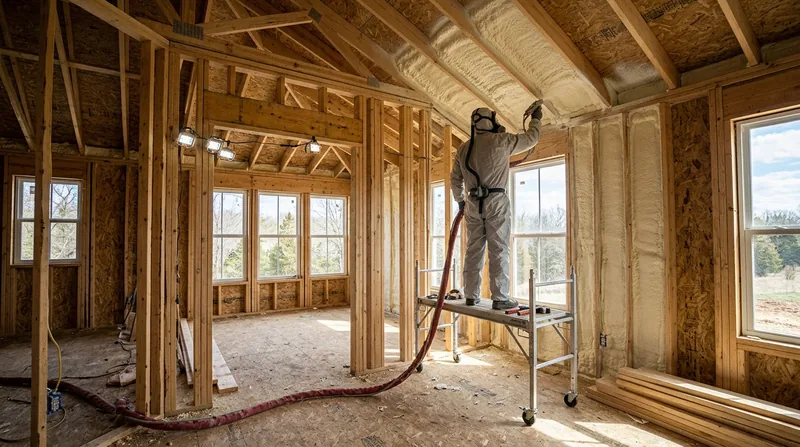




New construction and commercial builds across Columbia and the surrounding counties benefit enormously from spray foam insulation planned in from the start. Whether you're framing a new subdivision south of town, raising a metal building on acreage near Ashland, or finishing a barndominium conversion in Boone County, commercial and new construction spray foam insulation in Columbia delivers air sealing and thermal control that fiberglass and blown-in cannot match. We work alongside builders on active projects, foaming walls and roof decks before drywall goes up, coordinating with your general contractor's timeline and the building inspector's requirements. The mixed-humid climate here, with hot summers that drive moisture inward through walls and attics, and hard winters that reverse that pressure, means the building envelope must be sealed tight from day one. Getting spray foam right during framing costs less than retrofitting a leaky shell two years later, and it eliminates the weak points that plague older Columbia homes: rim joist leaks, vented attic heat loss, and condensation on rim band joists that rot framing from the inside out.
Why Commercial and New Construction Spray Foam Matters in Columbia's Building Market
Columbia's building stock ranges from older homes near downtown and the University of Missouri campus to mid-century ranches across established neighborhoods and newer subdivisions spreading south and east toward Ashland and Rocheport. New construction in these corridors sits on basements or crawl spaces, and the moisture that pools in those spaces during Missouri's humid summers will find its way into walls and attics if the envelope is vented or poorly sealed. Hard freezes and ice storms reverse that moisture drive in winter, pushing condensation back through rim joists and band boards. A sealed roof deck and foam-insulated walls planned into the frame stop that cycle before the first drywall screw goes in.
- Spray foam applied during framing eliminates air leakage before drywall and siding hide it.
- Closed cell and open cell foam both work in new construction, depending on your R-value target and budget.
- Coordination with your builder's schedule and the local building inspector ensures no delays and full compliance with energy code.
- A sealed envelope reduces HVAC load and cooling and heating bills from day one, not after ten years of settling and air leaks.
Planning spray foam into new construction is the single most cost-effective way to build a tight, durable home or commercial shell in this climate.
Key info: Columbia's building code, enforced by the city building department, governs attic ventilation, ignition barriers, and thermal barriers for new construction. The fifteen-minute thermal barrier requirement applies to spray foam in certain cavities, and naming it correctly is the expertise signal that separates a local shop from a rig-and-run crew. Always verify the specific requirements at your address with your local building official before foam is ordered.
For more detail on how spray foam performs in sealed roof decks and attics, see our attic spray foam insulation page.
How We Coordinate Spray Foam Installation with Your New Construction Timeline
New construction moves fast, and spray foam must fit into your framing and drywall schedule without slowing the job down. We work directly with your general contractor and the building inspector to schedule foam application at the right moment, usually after the frame is up and roof decking is installed but before drywall and exterior finish. Our crew arrives with a written estimate that specifies R-value, foam thickness, and coverage area, so your builder knows exactly what's being installed and can verify it against the energy code and the contract specs.
- We schedule around your builder's frame and drywall timeline, typically one to two days before drywall installation begins.
- Our crew applies foam to walls, roof decks, rim joists, and crawl space rim band in a single visit, then leaves mechanical ventilation running for the manufacturer-specified cure time.
- We provide a written estimate with R-value and thickness specs so your builder can verify the work against the energy code and your contract.
- We coordinate with the building inspector and provide documentation of the thermal barrier and ignition barrier installation as required by code at your address.
On a new subdivision build in Ashland or a metal building shell near Hallsville, this coordination keeps the job on schedule and eliminates the finger-pointing that happens when trades don't communicate.
Example: A new ranch subdivision south of Columbia frames up in spring, with drywall scheduled to start four weeks later. We foam the walls and sealed roof deck in week two, run mechanical ventilation for forty-eight hours, and leave the site ready for drywall. The builder stays on schedule, the inspector signs off, and the homeowner moves in with a tight, efficient envelope from day one.
For detail on how we approach air sealing and the specific techniques we use, visit our air sealing page.
Spray Foam Methods for New Construction and Commercial Builds
New construction projects in Columbia and surrounding counties call for two main approaches: closed cell foam for maximum R-value and moisture control on sealed roof decks and rim joists, and open cell foam for walls and attics where cost and sound dampening matter more than the highest R-value. Both are installed by the same crew using the same equipment, and your builder's energy target and budget determine which is right for your project.
| Approach | Description | Best for |
|---|---|---|
| Closed Cell Spray Foam | High-density foam, R-6.5 to R-7 per inch, vapor barrier, moisture control, applied in thin passes to specified thickness. | Sealed roof decks, rim and band joists, metal buildings, and any cavity where moisture risk is high and R-value must be maximum. |
| Open Cell Spray Foam | Lower-density foam, R-3.5 to R-4 per inch, air barrier but not vapor barrier, sound dampening, applied to fill cavity depth. | Interior walls, attics, and garages where budget and sound control are priorities and the cavity can dry to the exterior. |
| Combination (Closed + Open) | Closed cell rim band and roof deck, open cell interior walls, delivers moisture control where it matters and cost savings where they do. | Mixed-use commercial buildings, barndominiums, and new construction where budget and performance must both be optimized. |
| Removal and Replacement | Old or failed insulation removed, substrate cleaned and prepped, new foam applied to current code and energy target. | Renovation projects, additions, and any new construction built over or adjacent to older structures with existing insulation. |
See our closed cell spray foam page for detail on R-value performance and moisture control in this climate.
Commercial and New Construction Spray Foam Cost in Columbia: What to Expect
Spray foam pricing for new construction depends on the square footage of walls and roof deck to be foamed, the R-value target, whether closed cell or open cell foam is specified, and the complexity of the cavities. A new ranch home in a Columbia subdivision will cost less than a metal building with a 60-foot span, and a sealed roof deck costs more per square foot than a standard wall cavity. The only way to know the cost for your project is to get a free commercial estimate from our crew, who will measure the frame, review your energy code requirements with your builder, and provide a written quote with R-value and thickness specs.
Most new construction spray foam jobs in Greater Columbia run from several thousand dollars for a single-family home to tens of thousands for a commercial shell or a large subdivision build. Travel is included in our pricing across Columbia and surrounding areas, so there are no surprise mileage charges. We respond to estimate requests within twenty-four hours at (573) 685-4104, and the estimate is free and no-obligation. If you want to compare options, getting two or three estimates from different contractors is smart and will give you confidence in the final number.
Factors that affect cost include the total square footage of foam application, the R-value and thickness specified by your builder or energy code, access to cavities and roof deck (some jobs require scaffolding or lifts), and whether the substrate is clean and dry. A sealed roof deck over a basement or crawl space may require additional prep or moisture control before foam is applied. We never spray over wet, contaminated, or leaking substrates, and we walk away if the moisture problem must be fixed first. That discipline is a selling point, not a caveat, because it means the foam will perform as specified and won't trap moisture that rots framing later.
For a detailed breakdown of pricing and what factors move the estimate up or down, visit our pricing page.
What to Look for When Hiring a Spray Foam Contractor Near Me in Columbia
Spray foam is a specialized trade, and hiring the right contractor matters more than price alone. The market includes rig-and-run crews operating out of an out-of-state trailer, national franchises with minimal local accountability, and local independents like us who live in the community and stand behind the work. When you are evaluating any spray foam insulation contractor near Columbia, ask the right questions and verify the answers yourself. A contractor who cannot or will not answer these questions clearly is a red flag.
- Ask the contractor to provide a written estimate that specifies R-value per inch, total thickness, and coverage area in board feet.
- Request references from three recent commercial or new construction projects in your area, and call those references to ask about quality, timeline, and how the contractor handled any issues after the job.
- Verify that the contractor is fully insured and ask for a certificate of insurance naming your builder or property as an additional insured for the duration of the job.
- Confirm that the contractor understands the thermal barrier and ignition barrier requirements for your specific address and energy code, and ask how they will document compliance for the building inspector.
- Ask about the cure time and re-entry window after foam is applied, and confirm that mechanical ventilation will run for the full manufacturer-specified period.
- Get the contractor's response time for estimate requests and any questions that come up after the job is complete, and verify that they are reachable by phone at a local number.
Hiring a local contractor who knows Columbia's building code, responds fast, and stands behind the work saves headaches and protects your investment in a new building.
When you are ready to move forward, contact us for a free commercial estimate at (573) 685-4104, and we will walk you through the process and answer any questions about how spray foam fits into your new construction timeline and budget.
Commercial & New Construction Spray Foam in Columbia: Pricing Guide
| Service | Price | Details |
|---|---|---|
| Free Commercial Estimate | Free | Written estimate with R-value, thickness, and board-foot coverage for your specific project, no obligation to book |
| New Construction Spray Foam (Closed Cell) | Starting at $3,500 | Sealed roof deck, rim and band joists, moisture control, typical single-family new construction in Columbia area |
| New Construction Spray Foam (Open Cell) | Starting at $2,200 | Interior walls, attic, sound dampening, lower R-value option for budget-conscious new builds in mixed-humid climate |
| Commercial or Large-Scale New Build | On Estimate | Metal buildings, barndominiums, multi-unit projects, subdivisions require on-site measurement and energy code review before pricing |
| Travel and Coordination | Included | No separate mileage or travel fee across Columbia, Ashland, Hallsville, Centralia, and surrounding Boone County service areas |
Indicative pricing, the exact cost depends on square footage, finish, and site access. Free personalized estimate within 24h at (573) 685-4104.


