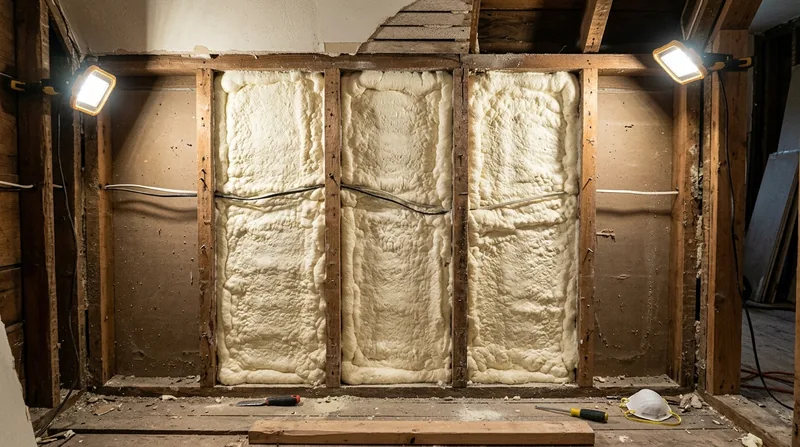




Open Cell Spray Foam Insulation in Columbia addresses a real problem in this mixed-humid climate: summer heat and moisture drive inward through walls and attics, while winter cold snaps reverse the pressure and push moisture back out. Columbia's housing stock ranges from older homes near downtown and the University of Missouri campus, many with shallow attic insulation and balloon framing, to mid-century ranches across established neighborhoods and newer subdivisions spreading south toward Ashland. Most sit over basements or crawl spaces that stay damp much of the year. Open cell foam expands to fill stud bays and rafter cavities, creating an air barrier that controls drafts, sound, and the moisture swings that plague this region. It costs less than closed cell and works well for attics and interior walls where the lower R-value per inch is acceptable and where vapor permeability is an asset rather than a liability. We've been installing spray foam insulation since 2014 across Boone County and the surrounding area, and we know which jobs call for open cell and which don't.
Why Open Cell Spray Foam Matters in Columbia's Humid Climate
Columbia sits in IECC climate zone 4A, a mixed-humid region where indoor moisture is the enemy. Vented attics bake through Missouri summers, drawing humid air through ceiling leaks and rim joists, then lose heat fast in January cold snaps when the moisture drive reverses. Rooms over garages, older rim and band joists, and leaky top plates are common weak points in the housing stock from Hallsville to Centralia. Open cell foam seals these pathways and allows the wood framing to dry to the interior if moisture does get in, which is why it performs better than closed cell in many older homes where vapor control isn't the priority and cost matters.
- Open cell foam expands to fill cavities completely, stopping air leaks that fiberglass batts and blown-in cellulose miss.
- The material is vapor permeable, allowing moisture trapped in walls and attics to migrate inward where HVAC systems can remove it.
- Installation cost runs 40 to 50 percent lower than closed cell, making it the right choice for attics and interior walls where R-value per inch is not the constraint.
- Sound dampening is a real benefit in older homes near the MU campus converted to student rentals, where interior noise control saves sanity.
- A proper open cell installation includes mechanical ventilation during cure and a re-entry window of 24 to 48 hours, which protects occupants and prevents the lingering odor that marks bad spray foam work.
When you choose open cell spray foam, you're choosing a product that works with Columbia's climate, not against it.
Key info: Missouri's building code governs attic ventilation, ignition barriers, and thermal barriers at your address. The fifteen-minute thermal barrier distinction is the detail most installers get wrong. Always verify what applies at your location with your local building department before work begins.
For more detail on how open cell compares to other foam options, see our guide to closed cell spray foam insulation, which handles condensation control on metal buildings and sealed rim joists where vapor impermeability is essential.
How We Install Open Cell Spray Foam Insulation in Columbia
Every open cell job starts with a walk-through to understand the existing insulation, air leakage pathways, and moisture history of the space. We measure the area, note any wet spots or prior water damage, and recommend whether open cell is the right call or whether closed cell, removal and replacement, or blown-in insulation makes more sense. If open cell is the answer, we schedule the work around weather and building occupancy, prepare the space with mechanical ventilation in place, and spray to the thickness and R-value specified in the estimate. We do not spray over wet, contaminated, or leaking substrates. We fix the moisture first or we walk away.
- We inspect the existing insulation and identify all air leakage points, including rim joists, top plates, and ductwork penetrations.
- We set up mechanical ventilation to run during the spray and cure process, protecting occupants from isocyanate and VOC exposure.
- We spray open cell foam in thin, controlled passes, allowing each pass to rise and cure before the next layer goes down, ensuring uniform density and adhesion.
- We verify thickness and R-value on site and document the work with photos and a written estimate that spells out the coverage area, board footage, and re-entry window.
- We schedule a 24 to 48 hour re-entry window before the space is occupied, and we provide clear guidance on ventilation and odor management during cure.
This process takes longer than a quick spray-and-go, but it delivers a job that performs and doesn't leave you fighting smell and off-gassing for weeks.
Local example: A 1960s ranch in Ashland with an attic full of settled fiberglass and a rim joist that sweats every summer. We removed the old insulation, sealed the rim joist and top plate with open cell, then topped the attic with 5 inches of open cell over the existing rim and band joists. The homeowner saw a noticeable drop in cooling bills and no more condensation on the rim board by mid-July. Total board footage was 480, and the job took two days including prep and cure time.
Learn more about how attic spray foam insulation integrates with open cell in older homes.
| Approach | Description | Best for |
|---|---|---|
| Open Cell Attic Top-Up | Spray 3 to 6 inches of open cell over existing insulation to boost R-value and seal air leaks. | Attics with settled fiberglass or cellulose and sound attic structure. |
| Open Cell Wall Retrofit | Inject open cell into existing wall cavities via holes drilled from the exterior or interior, no demolition required. | Pre-1980 homes with empty or poorly insulated stud bays, exterior or interior access available. |
| Open Cell Rim and Band Joist | Spray open cell around rim and band joists to seal the rim and stop air infiltration and moisture condensation. | Basements and crawl spaces in older homes where rim joists sweat or feel drafty. |
| Open Cell Interior Cavity Fill | Spray open cell into new construction wall cavities, garage walls, or interior partition walls for sound control and air sealing. | New builds, renovations, and rooms where sound dampening and draft control are priorities. |
Open Cell Spray Foam Insulation Cost in Columbia: What to Expect
Open cell spray foam costs starting at $0.55 per board foot for material and labor in the Columbia area, with the final price depending on job size, access, existing insulation, and whether removal or substrate repair is needed. A typical attic top-up of 400 to 600 board feet runs between $220 and $330 in material and spray labor, plus the cost of any insulation removal or moisture remediation. Wall injection jobs are smaller, often 100 to 200 board feet, so they run $55 to $110 for the foam alone. Rim joist work is even tighter, usually 50 to 150 board feet. The real variables are whether you're adding to existing insulation or starting from bare studs, whether the substrate is dry and sound, and whether permits apply at your address.
We always provide a written estimate that spells out the board footage, R-value, thickness, and labor cost before any work begins. If your job requires insulation removal, that's a separate line item and is often the largest cost in a retrofit. Two to three estimates from local contractors give you a real sense of market pricing and help you spot lowball bids that skip ventilation, skip documentation, or promise immediate re-entry. Call us at (573) 685-4104 for a free estimate, and we'll walk you through the numbers and the options.
See our full pricing overview for more detail on removal, travel, and complex jobs.
Open Cell Spray Foam Insulation Near Me: What Columbia Homeowners Should Know When Hiring
Spray foam insulation is not a commodity, and the difference between a careful installer and a rig-and-run crew shows up months after the job is done. When you're looking for a contractor, verify that they carry full insurance, ask for references from recent jobs in Columbia or nearby towns like Hallsville, Centralia, or Ashland, and get a written estimate that includes R-value, thickness, and re-entry time. Spray foam work is not licensed in Missouri at the state level, but your local building department can tell you whether permits apply to your project and what they require. If you're in an HOA or a historic district, check whether exterior work on metal buildings or additions requires architectural approval. Most importantly, ask any contractor whether they use mechanical ventilation during spray and cure, and whether they guarantee a 24 to 48 hour re-entry window. If they promise to let you back in the same day or claim the smell is normal and will fade, keep looking.
- Verify that the contractor carries general liability insurance and can provide a certificate of insurance before work starts.
- Request at least two references from homes or businesses within 20 miles of your address, and call them to ask about smell, performance, and whether the contractor was easy to reach after the job.
- Get a written estimate with board footage, R-value per inch, and total thickness, so you can compare apples to apples across contractors.
- Ask your building department whether permits apply to insulation work at your address, and do not hire a contractor who claims to know better than the building official.
- Confirm in writing that mechanical ventilation will run during spray and cure, and that the re-entry window is at least 24 hours, with clear guidance on odor management.
Hiring the right contractor protects your investment and keeps your home safe during and after the work.
Ready to get started? Contact us for a free, no-obligation estimate on open cell spray foam insulation in Columbia or surrounding areas.
Open Cell Spray Foam Insulation in Columbia: Pricing Guide
| Service | Price | Details |
|---|---|---|
| Open Cell Attic Top-Up | Starting at $0.55/board ft | Spray 3 to 6 inches over existing insulation; price moves up with removal, substrate repair, or complex access |
| Open Cell Wall Injection Retrofit | Starting at $0.55/board ft | Inject into existing stud cavities without demolition; 100 to 300 board feet typical; access and cavity depth affect final cost |
| Open Cell Rim Joist and Band Joist | Starting at $0.55/board ft | Seal rim board and stop air infiltration; typically 50 to 200 board feet; moisture remediation or framing repair adds to estimate |
| Insulation Removal and Replacement | On estimate | Removal cost depends on volume and disposal; combined with open cell spray, total job needs on-site measurement before pricing |
| Travel and Mobilization | Included | No separate travel charge for jobs in Columbia, Ashland, Hallsville, Centralia, and surrounding Boone County service area |
| Free Estimate | No cost | Written estimate with board footage, R-value, and re-entry window; response within 24 hours at (573) 685-4104 |
Indicative pricing, the exact cost depends on square footage, finish, and site access. Free personalized estimate within 24h at (573) 685-4104.


