Understanding R-Value and Your Home's Insulation Needs
When homeowners in Columbia start thinking about upgrading their attic insulation, one of the first questions is always about R-value. R-value measures thermal resistance, or how well a material prevents heat from moving through it. The higher the R-value, the better the insulation performance. However, understanding what R-value your home actually needs is more nuanced than simply picking the highest number available.
The spray foam insulation R value per inch varies depending on the type of foam you choose. Open cell spray foam typically provides about 3.5 to 3.6 R-value per inch, while closed cell spray foam delivers approximately 6 to 7 R-value per inch. This significant difference means that closed cell foam requires less thickness to achieve the same thermal performance, which can be important if you have limited attic space. Understanding these distinctions helps you make an informed decision about which product will work best for your specific situation and budget.
R-Value Requirements by State: What Missouri Expects
Missouri's climate falls in a moderate zone that requires specific insulation standards for new construction and major renovations. The R value requirements by state are determined by the International Energy Conservation Code (IECC), which Missouri has adopted into its building standards. For attics in Missouri, the current recommendation is typically R-38 to R-60, depending on whether you're in the northern or southern part of the state and the specific type of heating system you use.
Columbia, located in central Missouri, generally falls into a zone requiring R-38 minimum for attic insulation. However, many energy-conscious homeowners and builders are opting for higher values like R-49 or R-60 to maximize energy efficiency and reduce long-term utility costs. If you're unsure where your home stands relative to current code, a professional energy audit can identify any gaps and recommend the appropriate upgrade path for your specific property.
Air Sealing vs. Full Foam: When Each Makes Sense
Not every home needs a complete spray foam overhaul. Sometimes strategic air sealing is the smarter first step. Air sealing focuses on closing gaps, cracks, and penetrations where conditioned air escapes or outside air infiltrates. Common problem areas include rim joists, ductwork, electrical outlets, and pipe penetrations. When done correctly, air sealing can significantly improve your home's energy performance without the expense of full insulation replacement.
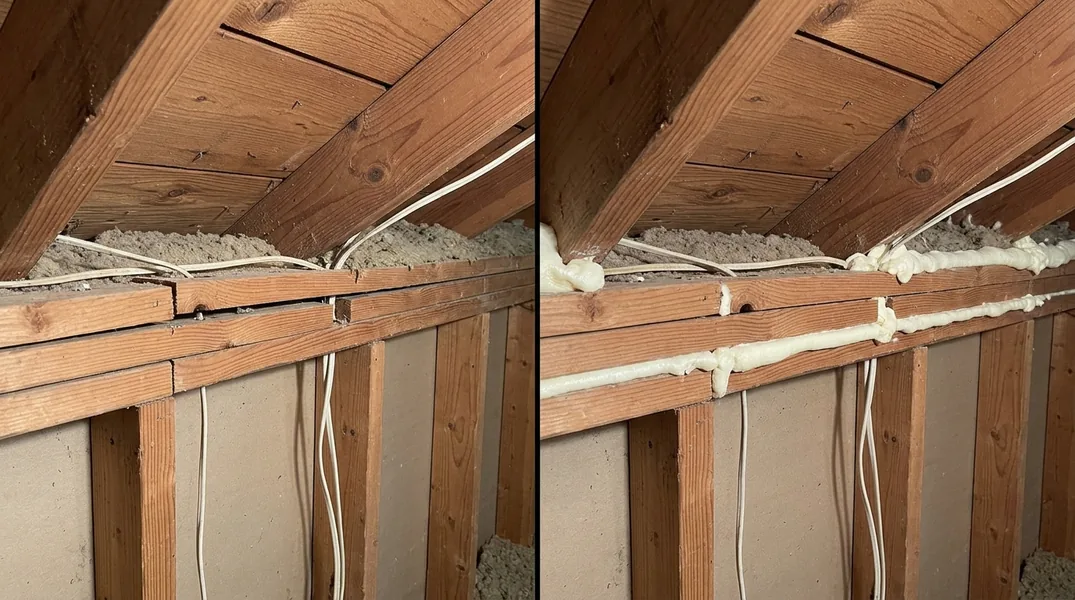
A full Attic Spray Foam Insulation job, on the other hand, replaces or supplements existing insulation with a continuous thermal and air barrier. This approach works best when your current insulation is inadequate, damaged, or unevenly distributed. If your attic currently has old fiberglass batts with settled areas, moisture damage, or pest contamination, spray foam provides superior air sealing plus thermal resistance in one application. The key is having a qualified contractor assess your home's current condition and energy performance to determine which approach will deliver the best return on investment.
How Thick Should Spray Foam Be: Finding the Right Thickness for Your Attic
The question of how thick should spray foam be depends on your target R-value, the type of foam you select, and your budget constraints. If you're using open cell foam to reach R-38, you'll need approximately 10 to 11 inches of material. The same R-value with closed cell foam requires only about 5.5 to 6.5 inches. For higher performance goals like R-49 or R-60, thickness increases accordingly, though closed cell remains more space-efficient.
Your attic's rafter depth plays a practical role in this decision. If your rafters are 6 inches deep, closed cell foam can fill the cavity and provide an excellent thermal barrier. With open cell foam in the same space, you'd only achieve about R-21, which may be insufficient. Professional installers from Columbia Spray Foam Insulation evaluate your attic's dimensions, existing insulation, and ventilation requirements to recommend the optimal thickness and product type. Getting this calculation right ensures you meet code requirements while maximizing energy savings without wasting material or money.
Tax Credits and Rebates: Reducing Your Insulation Investment
Many homeowners don't realize that upgrading to spray foam insulation can qualify them for significant financial incentives. The insulation tax credit allows homeowners to claim a percentage of qualifying insulation expenses on their federal tax return. For 2024, the Inflation Reduction Act provides up to 30% credit on certain home energy improvements, including insulation upgrades, up to a maximum of $3,600 per year. This represents a substantial reduction in your out-of-pocket costs and can make the decision to upgrade much more affordable.
Beyond federal tax credits, many utility companies and local programs offer insulation rebates to encourage energy-efficient upgrades. Ameren Missouri, which serves the Columbia area, periodically offers rebate programs for insulation improvements. These rebates can range from a few hundred to several thousand dollars depending on the scope of your project and current program availability. Before scheduling your installation, contact your utility provider to ask about active rebate programs and eligibility requirements. Combined with tax credits, these incentives can offset 40% to 50% of your total project cost, making professional spray foam insulation a much more attractive investment.
Attic Spray Foam Insulation Cost in Columbia: What to Budget
Understanding the financial investment required for spray foam insulation helps you plan your project effectively. The cost varies based on attic size, existing conditions, foam type, and desired R-value. Closed Cell Spray Foam Insulation typically costs more per board foot than open cell, but requires less thickness to achieve equivalent R-values, which can offset the higher material cost. Open cell foam is more budget-friendly upfront but requires greater thickness, which may increase labor costs in some scenarios.
Most homeowners in the Columbia area can expect professional spray foam insulation projects to range from several hundred dollars for targeted air sealing to several thousand dollars for comprehensive attic coverage. The best way to understand your specific investment is to request a free estimate from Columbia Spray Foam Insulation. During this consultation, our team will assess your attic, discuss your energy goals, explain the benefits of different foam types, and provide transparent pricing based on your actual needs. When you factor in federal tax credits, utility rebates, and long-term energy savings, the true cost of upgrading becomes significantly lower than the initial quote.
Making Your Decision: Questions to Ask Before Committing
Before scheduling your spray foam installation, take time to ask yourself and your contractor several important questions. What is your primary goal: reducing energy bills, improving comfort, addressing moisture issues, or some combination? How long do you plan to stay in your home, and what payback period makes sense for your situation? Are there any existing ventilation or moisture concerns that need to be addressed before adding insulation? Understanding your priorities helps ensure the solution matches your actual needs.
It's also worth asking your contractor about the differences between Open Cell Spray Foam Insulation and closed cell options for your specific application. Each has distinct advantages regarding cost, performance, and suitability for different attic conditions. If your home has existing moisture problems, closed cell is often the better choice. If budget is the primary concern and your attic has adequate ventilation, open cell may serve you well. Columbia Spray Foam Insulation's team is ready to answer all your questions and help you make an informed choice. Call us at (573) 685-4104 or request a free estimate to get started on your insulation project today.
Looking for a professional spray foam insulation contractor in Columbia? Columbia Spray Foam Insulation responds fast for all your spray foam insulation needs.
Get a Free Quote